
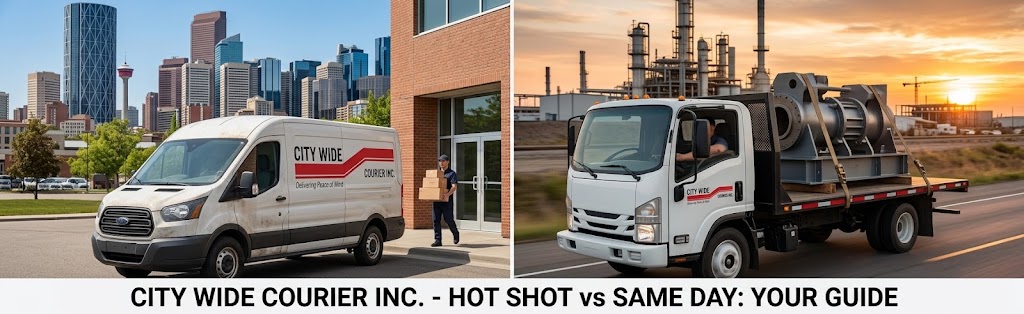
You need something delivered fast, and now you’re stuck staring at two options that sound almost identical. Hot shot delivery and same day delivery both promise speed. Both get used interchangeably by people who’ve never had to actually book one. But if you run a business in Calgary and you’re weighing hot shot delivery vs same day delivery for an upcoming shipment, the differences matter more than the marketing copy lets on.
The short version: same day delivery shares a vehicle and a route with other deliveries, while hot shot delivery gives your shipment a dedicated vehicle and driver with nothing else on board. That one distinction changes your cost, your timeline, and what kind of cargo makes sense for each service.
We’ve been running deliveries across Calgary and Alberta since 1986, so we’ve fielded this question more times than we can count. Here’s what actually separates these two services, and how to figure out which one your shipment needs.
What Is Same Day Delivery?

Same day delivery is exactly what it sounds like: your package gets picked up and dropped off within the same business day. It’s the workhorse of local courier work. A driver picks up your item, adds it to a route with other stops, and works through deliveries in a logical order to keep things efficient.
Same day courier service typically runs on cars, cargo vans, or small cube vans. The driver might have three or four other pickups and drop-offs before or after yours, depending on where you fall on the route. That’s not a downside. It’s how the service keeps rates reasonable for everyday shipments like documents, small parcels, retail exchanges, and business-to-business deliveries.
Most same day delivery still moves quickly. A package picked up in the morning in one part of Calgary can realistically be sitting on someone’s desk in another part of the city by early afternoon. It’s not instant, but it’s dependable, and for the majority of urgent-but-not-critical deliveries, it’s the right tool for the job.
Businesses often build same day delivery into their regular operations rather than treating it as a one-off emergency service. Law firms use it for filings that need to reach a courthouse before end of business. Retailers use it for exchanges between store locations. Medical offices use it for lab samples and paperwork that need to move across town without waiting on regular mail. The common thread is that these deliveries are urgent enough to skip the mail, but not so time-sensitive that a shared route becomes a problem. If timing is a little more flexible, a next day delivery service can also stretch the budget further without sacrificing reliability.
What Is Hot Shot Delivery?
Hot shot delivery is a different animal. Instead of sharing a route, your shipment gets its own dedicated vehicle and driver, with no other stops until your delivery is complete. The driver goes straight from pickup to drop-off, sometimes across the city and sometimes across the province.
The term “hot shot” comes from the trucking industry, where it originally described using smaller, faster trucks to haul urgent freight instead of waiting for a full truckload. Today, it covers everything from a sprinter van running an urgent part to an oilfield site, to a pickup with a gooseneck trailer hauling a piece of industrial equipment, to a flatbed trailer moving construction materials that can’t wait for a scheduled freight run. In Alberta, commercial vehicles used for this kind of work fall under provincial safety and compliance rules, and organizations like the Alberta Motor Transport Association publish guidance for carriers operating these heavier trucks and trailers.
Hot shot trucking vs courier service is really a question of scale and exclusivity. A regular courier shares capacity. A hot shot service does not. That exclusivity is exactly why it costs more, and exactly why it exists.
Vehicles used for hot shot delivery vary quite a bit depending on the cargo. A sensitive medical shipment might only need a sprinter van or a standard cargo van, as long as it gets exclusive use. A piece of industrial machinery might call for a medium-duty truck or a pickup with a gooseneck trailer. Larger or awkwardly shaped freight often moves on a flatbed trailer. What ties all of these together isn’t the vehicle itself, it’s the fact that nothing else is loaded alongside your shipment.
Hot Shot Delivery vs Same Day Delivery: The Core Difference
If you remember nothing else from this article, remember this: same day delivery is about the day, and hot shot delivery is about the vehicle.
Same day delivery guarantees a delivery window measured in hours, shared with other stops. Hot shot delivery guarantees exclusive use of a vehicle from pickup to drop-off, with speed as a byproduct of that exclusivity rather than the whole point.
Here’s a side-by-side breakdown to make the comparison concrete.
| Factor | Same Day Delivery | Hot Shot Delivery |
|---|---|---|
| Vehicle use | Shared with other stops on a route | Dedicated to your shipment only |
| Typical vehicles | Cars, cargo vans, small cube vans | Sprinter vans, box trucks, flatbeds, gooseneck trailers, Class 3-5 trucks |
| Speed | Delivered within the business day | Direct, non-stop transit from A to B |
| Cost | Lower, shared-route pricing | Higher, dedicated-vehicle pricing |
| Best for | Documents, small parcels, retail items | Time-critical parts, industrial equipment, oversized or high-value freight |
| Distance | Usually local, within the city | Local or long-haul across Alberta |
| Tracking | Standard route tracking | Real-time GPS with direct chain-of-custody |
When Should You Choose Hot Shot Trucking Over Same Day Delivery?
This is the question we get asked most, and the answer usually comes down to three things: urgency, cargo type, and distance.
Choose hot shot delivery when:
- A piece of equipment breaks down and production stops until the replacement part arrives (a “line-down” emergency)
- You’re moving oil and gas equipment, machinery, or industrial parts that can’t wait for a shared route
- The shipment needs to travel outside the city, say from Calgary to Red Deer, Edmonton, Lethbridge, or Medicine Hat, and timing is critical
- The cargo is oversized, requires a flatbed trailer, or needs specialized handling
- You need a guaranteed, non-stop transit time rather than a general delivery window
- Chain-of-custody matters, such as with sensitive legal documents or medical supplies that can’t be shared with other freight
Choose same day delivery when:
- You need something across town by end of day, not by the next available truck
- The item is small enough for a car, van, or cube van
- Budget matters more than having an exclusive vehicle
- You’re sending routine business deliveries, retail packages, or standard documents
- A general delivery window works fine and you don’t need minute-by-minute tracking of a dedicated driver
Is Hot Shot Delivery Faster Than Standard Same Day Shipping?
Not always, and this surprises a lot of people. Hot shot delivery isn’t automatically faster in every scenario. If your shipment is going three kilometres across downtown Calgary, a same day courier can likely get it there just as quickly as a dedicated hot shot vehicle, because the distance is short regardless of how many other stops the driver has.
Where hot shot delivery pulls ahead is on distance and reliability of timing. Once you’re moving freight to another city or region, a dedicated vehicle with no stops in between becomes noticeably faster than a route-based delivery that has to work through other commitments first. Hot shot delivery also gives you a firmer guarantee. There’s no risk of your shipment sitting behind someone else’s delivery because the driver’s route got backed up.
Think of it this way: same day delivery is fast within a shared system. Hot shot delivery is fast because there’s no system to share.
What Type of Cargo Requires Hot Shot Delivery?
Certain cargo just isn’t suited to a shared route, either because of urgency, sensitivity, or physical size. Common examples include:
- Line-down emergency parts for manufacturing or industrial operations, where every hour of downtime costs money
- Oil and gas equipment, a major driver of hot shot demand across Alberta
- Construction materials that need to arrive on a tight project schedule
- Medical supplies, including time-sensitive specimens, equipment, or pharmaceutical deliveries
- Legal documents like court filings, affidavits, and contracts with hard deadlines handled through a dedicated legal courier service
- Time-critical replacement parts for vehicles, equipment, or machinery
- LTL (less-than-truckload) freight that doesn’t justify a full transport truck but still needs dedicated handling
If your shipment fits into any of these categories, a dedicated vehicle usually earns its higher price tag through reliability alone.
How Far Can Hot Shot Delivery Drivers Haul Freight?
Hot shot delivery isn’t limited to city blocks. Because the vehicle is dedicated to a single shipment, drivers can cover long distances in a single non-stop run. In Alberta, that typically means routes connecting Calgary to Red Deer, Edmonton, Lethbridge, Medicine Hat, and everywhere in between.
The delivery radius depends on the provider’s fleet and coverage area, but a well-established hot shot service should be able to handle both a short cross-town run and a multi-hour highway trip with the same level of direct, exclusive routing. That flexibility is part of what separates dedicated hot shot delivery from a local courier that’s built primarily for shorter, city-based routes.
Hot Shot Delivery Cost vs Same Day Rate
Cost is usually the deciding factor once urgency and cargo type have been sorted out, so it’s worth being upfront about it.
Same day delivery is priced around shared efficiency. Because a driver can complete several deliveries in one route, the cost per shipment stays lower. This makes it the practical choice for routine, budget-conscious deliveries where a general delivery window is acceptable.
Hot shot delivery costs more because you’re paying for exclusivity: one vehicle, one driver, one shipment, no exceptions. Pricing generally reflects distance, vehicle type, and how quickly the pickup needs to happen. A flatbed trailer hauling industrial equipment to Edmonton will cost more than a sprinter van running an urgent document across Calgary, but both fall under the hot shot umbrella because both get dedicated, non-stop service.
| Consideration | Same Day Delivery | Hot Shot Delivery |
|---|---|---|
| Pricing model | Shared route, lower per-shipment cost | Dedicated vehicle, higher per-shipment cost |
| Best value for | Small, routine, local shipments | Urgent, high-value, or oversized shipments |
| Price drivers | Distance, package size, time of request | Distance, vehicle type, urgency, dedicated routing |
Neither option is objectively “better value.” The right choice is whichever one matches what’s actually being shipped and how much risk you can tolerate if it’s delayed.
Expedited Freight vs Same Day Delivery: A Quick Note
It’s worth separating hot shot delivery from the broader category of expedited freight. Expedited freight can include hot shot service, but it also covers larger-scale options like team-driven long-haul trucks or air freight, which are usually reserved for much bigger shipments over longer distances. For most Calgary businesses comparing local and regional options, the real decision is between a shared same day route and a dedicated hot shot vehicle, not between hot shot and full-scale freight logistics.
Direct Point-to-Point Delivery vs Local Route: Why It Matters for Reliability
A local route, by design, involves multiple stops. That’s efficient, but it also means your delivery time depends partly on what else is happening on that route that day. Traffic, a late pickup from another customer, or an unexpected stop can all shift your delivery window slightly.
Direct point-to-point delivery removes that variable entirely. The driver picks up your shipment and goes straight to the destination. For most deliveries, the shared-route trade-off is a non-issue. For time-critical shipments, it’s the entire reason hot shot service exists.
Making the Right Call for Your Business
If you’re still not sure which service fits, ask yourself a few quick questions:
- Would a delay cost me real money, downtime, or a missed deadline? If yes, lean toward hot shot.
- Is the shipment oversized, sensitive, or does it require specialized handling? If yes, lean toward hot shot.
- Is this a routine, local delivery with some flexibility in timing? If yes, same day delivery is likely the more cost-effective choice.
- Is the destination outside the city? Hot shot delivery tends to make more sense the farther the shipment needs to travel.
Most businesses end up using both services at different times, depending on what’s moving and how urgent it is. A construction company might use same day delivery for routine paperwork between job sites and switch to hot shot delivery the moment a piece of equipment goes down and production is on the line. An oil and gas operation might rely on same day couriers for office logistics while keeping a hot shot provider on call for line-down emergencies that can’t wait even an extra hour. A well-run courier partner should be able to offer honest guidance on which one fits a given shipment rather than upselling the more expensive option by default.
Frequently Asked Questions
Is hot shot delivery the same as expedited shipping?
Not exactly. Hot shot delivery is one form of expedited shipping, specifically defined by the use of a dedicated vehicle for a single shipment. Other forms of expedited shipping, like priority freight on a shared truck, don’t offer that same exclusivity.
Can same day delivery handle large or heavy items?
Sometimes, depending on the courier’s fleet. Many same day services use cube vans capable of handling moderately sized freight, but very large or oversized cargo, like machinery or construction materials, generally needs the dedicated space and vehicle type that hot shot delivery provides.
Do I need to book hot shot delivery in advance?
Not usually. Most hot shot services are built around fast dispatch, often getting a driver moving within 30 minutes to an hour of the request. That said, booking ahead when you know a time-critical shipment is coming helps avoid any delay in vehicle availability.
Is hot shot delivery only for businesses?
No. While industrial, oil and gas, and construction clients make up a large share of hot shot demand, individuals also use it for urgent personal shipments, like time-sensitive legal documents or medical items that can’t wait for a shared route.
What’s the difference between a courier and a hot shot trucking service?
A traditional courier typically handles smaller parcels and documents across shared local routes. Hot shot trucking scales that same idea up to larger freight and dedicated vehicles, including trucks and trailers capable of hauling equipment and industrial cargo, often over longer distances.
Does hot shot delivery come with tracking?
Reputable hot shot providers offer real-time GPS tracking and a clear chain-of-custody from pickup to delivery, which matters even more with a dedicated shipment where there’s no room for a handoff error.
Final Thoughts
Hot shot delivery and same day delivery both solve the same basic problem: getting something where it needs to go, quickly. The difference is in how they get there. Same day delivery works efficiently within a shared system, making it the practical choice for routine local shipments. Hot shot delivery removes the sharing entirely, offering a dedicated vehicle and direct routing for shipments where delay isn’t an option.
If you’re in Calgary or anywhere across Alberta and you’re not sure which service your next shipment needs, City Wide Courier has been sorting out exactly this question since 1986. Our fleet ranges from cars and cargo vans for same day work to dedicated trucks and trailers for hot shot runs to Red Deer, Edmonton, Lethbridge, Medicine Hat, and beyond. Call us at (403) 246-8349 or email info@citywidecourier.ca to talk through your delivery and get a straight answer on which option actually fits.