
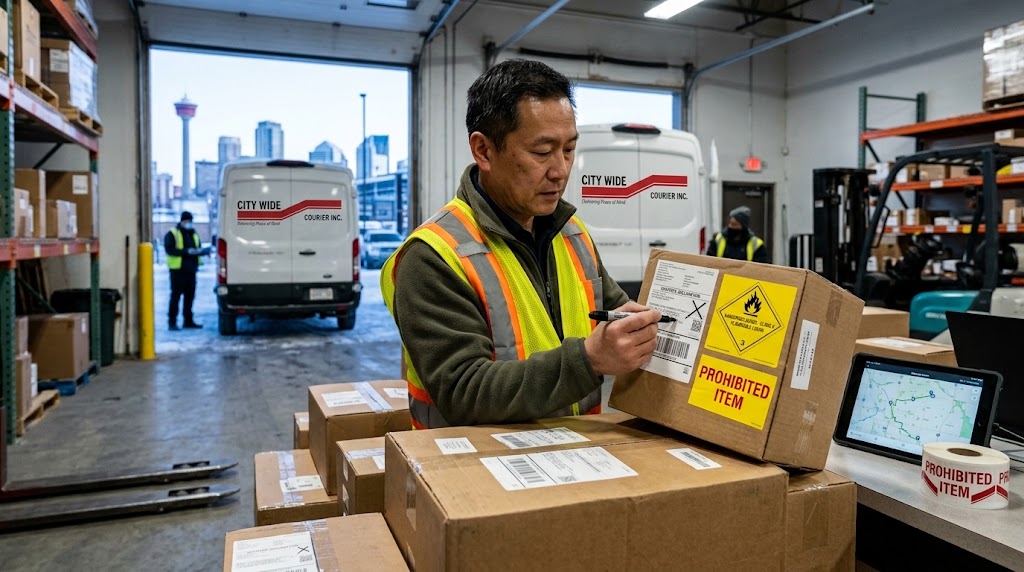
You booked the pickup. The driver shows up. Then someone reads the label on the box and says, “Sorry, we can’t take that.”
It happens more than you’d think. Our dispatchers field this question every week on everyday parcel delivery bookings. The prohibited items courier Calgary rules trip up homeowners and small businesses alike.
So here’s the full list for Calgary, Airdrie, Cochrane, Chestermere, Okotoks and the rest of Alberta. We’ll cover what’s banned outright, what’s allowed with conditions and what to do when your item falls in a grey zone.
Why couriers in Calgary refuse certain items
Couriers refuse parcels for three reasons: the law, safety or insurance.
The big one is the Transportation of Dangerous Goods Act and its regulations. They apply across Canada and Transport Canada enforces them. Anything that can catch fire, leak, explode or poison someone has strict rules for packing, labelling and paperwork. A courier driver carries dozens of parcels at once. One leaking bottle can ruin all of them (and hurt the driver).
Then there’s the Criminal Code and the Controlled Drugs and Substances Act. A courier can’t legally carry firearms without proper license. Illegal drugs are out completely. Those rules come from federal law.
Insurance is the third piece. Carriers cap what they’ll cover. Cash and jewellery usually fall outside that cap so most won’t take them.
The sender carries the responsibility. If you mislabel a parcel or hide what’s inside you’re the one who answers for it.
For the official rulebook, Transport Canada keeps a dangerous goods guide that explains classes and labelling in plain terms.
Prohibited items courier Calgary: 15 things you can’t send
Items 1 to 9 are banned or close to banned for ordinary senders. Items 10 to 15 are the ones people mail by accident.
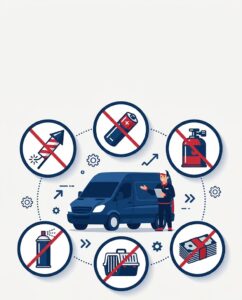
1. Explosives, fireworks and ammunition
This is the clearest no. Fireworks, flares, blasting caps, detonators and live ammunition can’t go in a regular courier van. That includes a single box of shotgun shells.
Pyrotechnic items and ammunition fall under Class 1 of the dangerous goods rules. Only licensed specialty carriers with trained drivers can move them.
Alberta has plenty of hunters and sport shooters. If that’s you, call the retailer who sold you the ammunition. They’ll know the licensed carriers.
2. Firearms and weapons
Firearms need licences at every step in Canada. A standard courier can’t take a rifle, handgun or restricted weapon from you.
The same goes for prohibited devices, switchblades and anything else the Criminal Code treats as a weapon. Even replica firearms cause trouble because a driver can’t tell the difference at a glance.
Gun shops ship through licensed channels. If you need to move a firearm after an inheritance or a sale talk to the Canadian Firearms Program first.
3. Illegal drugs and unlicensed cannabis
Illegal drugs are out. That one’s obvious.
Cannabis is where it gets muddy. It’s legal to buy in Alberta from licensed retailers. But sending it between private people is still against the law. Only licensed producers and provincial retailers can ship it. Even they follow strict rules set by the Alberta Gaming, Liquor and Cannabis Commission (AGLC).
So you can’t courier a bag of cannabis to a friend in Edmonton.
4. Flammable liquids and gases
Gasoline, lighter fluid, propane tanks, acetone, paint thinner and butane all count here. So do most aerosol cans in bulk.
Small consumer quantities sometimes move under “limited quantity” rules. Those rules demand specific packing and marks. Most local couriers simply decline them. The risk isn’t worth it.
Spray paint is a classic example. One can in a sealed box might be fine with the right carrier. Twelve cans won’t be.
5. Loose lithium batteries
Lithium batteries can short out and burn hot. That’s why they get special attention.
A phone or laptop with the battery installed usually travels fine. A loose spare battery pack, a damaged battery or a bulk shipment of cells needs dangerous goods handling.
If your parcel has anything with a swollen or dented battery in it, don’t ship it at all. Take it to a proper recycling drop-off.
6. Corrosives, poisons and toxic chemicals
Battery acid, drain cleaner, pesticides, bleach concentrates, mercury and rat poison all belong on this list. So does asbestos.
Pool chemicals trip people up every spring. Chlorine tablets look harmless in a tub. They react badly with moisture and other chemicals though. Couriers won’t take them.
7. Radioactive and infectious materials
Radioactive sources, medical waste and infectious substances are banned for ordinary senders.
Lab samples are a separate matter. Certified packaging and a trained pharmaceutical courier can move certain diagnostic specimens. That’s specialist work that you can’t set up with a regular parcel booking.
8. Live animals
Dogs, cats, birds, reptiles, fish, bees and insects can’t go by courier van. The stress alone could kill a small animal. Carriers aren’t set up to look after them.
Pet transport companies and airlines with animal programs handle this properly.
9. Human remains
Human remains and cremated ashes need special permits and funeral-trade handling. A courier won’t take them.
Funeral homes arrange this through licensed transfer services. If you’re helping family move ashes start with the funeral director.
10. Cash, bearer bonds and precious items
Here’s where careless senders get burned. Most couriers won’t carry cash, gift cards loaded with funds, bearer securities or loose gemstones. If a parcel goes missing there’s no way to prove what was inside.
Jewellery and watches fall into a grey area. Some carriers take them with declared value and signature. Many don’t.
Moving cheques or legal documents? That’s different. Those go all the time. A legal courier handles them with signed proof of delivery.
11. Counterfeit and pirated goods

Fake designer bags, knockoff electronics, pirated DVDs and copied software are banned. If a driver or the Canada Border Services Agency opens the box the goods can be seized and the sender can face charges.
A courier company can’t knowingly carry counterfeit goods and stay in business. Leave them out of the parcel.
12. Obscene material and hate propaganda
The Criminal Code bans certain obscene material and hate propaganda. Couriers can’t transport it.
Most senders never come near this category. It matters for printers, publishers and online sellers who ship printed material in volume. If you handle imported books or posters, check what’s in the box before it goes out.
13. Perishable food and dry ice
Fresh food, raw meat, fish and dairy spoil fast. Most couriers won’t take them unless the service is built for it.
Dry ice is its own problem. It gives off carbon dioxide gas as it melts. It can burst a sealed container. It’s classed as a dangerous good so it needs vented packaging and marks.
If you run a bakery or a catering shop in Calgary, ask us about same-day courier service instead. A short trip beats a long chilled one.
14. Alcohol and tobacco
Alcohol isn’t banned everywhere. It is restricted though. In Alberta, deliveries typically need an adult to sign for them. Many carriers refuse bottles because they break.
Tobacco and vape products have their own tax and age rules. Without proper licensing don’t ship them.
15. Wildlife, plants and protected species products
Ivory, certain furs, shells, coral and parts of protected animals need permits under CITES (the international wildlife trade treaty). Alberta also has its own wildlife rules, so antlers, hides and hunting trophies often need paperwork.
If your item came from an animal and you’re not sure it’s legal, assume you need paperwork.
Prohibited vs restricted: what’s the difference?
People mix these up. A prohibited item can’t go by that carrier under any conditions. A restricted item can go if you follow the rules.
| Item | Status with most local couriers | What you usually need |
|---|---|---|
| Fireworks and ammunition | Prohibited | Licensed specialty carrier |
| Firearms | Prohibited | Licences and a certified carrier |
| Cannabis | Prohibited for private senders | Licensed producer or retailer |
| Lithium batteries (installed in device) | Restricted | Secure packing with battery protected |
| Loose lithium batteries | Restricted or prohibited | Dangerous goods handling |
| Aerosols and paint | Restricted | Limited quantity packing and marks |
| Dry ice | Restricted | Vented packaging and labels |
| Alcohol | Restricted | Age check and adult signature |
| Prescription medicine | Restricted | Proper labelling and a licensed courier |
| Cash and jewellery | Often declined | Declared value or a different service |
| Live animals | Prohibited | Pet transport service |
This table is a general guide. Each carrier sets its own rules so always check before you book.
Medications and medical items in Calgary: what’s allowed
Medicines are the biggest grey zone we deal with.
Prescription drugs can move by courier but not casually. Pharmacies, clinics and labs use licensed couriers who know how to handle labelled medications and temperature-sensitive items. Controlled substances such as opioids need extra paperwork under federal law.
Don’t post pills in an envelope to a family member. It’s a bad idea that can also break the law.
If you work in healthcare or run a pharmacy, our pharmaceutical courier service is built for exactly this. Drivers understand temperature needs and signature handling. You get proof of delivery for every drop.
Calgary and Alberta: local things to know
A few local points come up again and again.
Winter changes everything: Calgary can swing from a chinook to minus 30 in a day. Liquids freeze and burst. Batteries lose charge. Anything temperature-sensitive needs thought before it leaves your door. Shorter trips help, which is one of the advantages of same-day delivery service in a Calgary winter.
Nearby communities follow the same rules: A parcel going to Airdrie, Cochrane, Chestermere or Okotoks is subject to the same limits as one going downtown. Distance doesn’t change what’s allowed.
Long runs across Alberta: Heading to Red Deer, Edmonton, Lethbridge or Medicine Hat? The same prohibited list applies. A longer trip also means more time in the vehicle so temperature-sensitive items need extra thought. A hot shot delivery keeps your package alone in the vehicle on those runs. Our post on choosing a hotshot courier service in Calgary covers what to ask before you book.
Alcohol and cannabis rules: Retailers and licensed sellers have their own delivery requirements under AGLC rules. If you’re a business, confirm your licence conditions before booking a courier.
Bulky items are a separate question: Large oversized loads aren’t prohibited. They need the right vehicle. Our fleet includes cars, vans and five-ton trucks with power lift tailgates so size is rarely the issue.
How to pack restricted items so they get accepted
Restricted items travel only when they’re packed right. A good box can be the difference between a pickup and a refusal.
- Use a rigid outer box with cushioning on every side
- Seal liquids in leak-proof containers and put each one in a second sealed bag
- Keep spare batteries out of the parcel unless the courier has said yes
- Mark the box “fragile” and “this side up” when it applies
- Write the sender and receiver names and phone numbers on the outside
- Tuck a packing slip inside with the exact contents
Drivers can’t accept a box that rattles or drips. That goes for every parcel delivery we pick up. Spend five minutes on packing and you’ll save an hour of phone calls.
Shipping every day? Build a short checklist
If you run a shop or an office in Calgary that sends parcels weekly, a small internal list pays off fast.
Write down every product you sell that has a battery, a liquid or an aerosol can. Mark each one “ask first.” Give that list to whoever packs the boxes.
Tell your courier about those items up front. A repeat client who explains the contents saves the dispatcher time and gets faster answers. If you want a billing record for your own books you can set up an online account or just call for single bookings with no account at all.
What if your item is urgent but restricted?
A banned item stays banned at any speed.
A lot of restricted items become manageable with the right service though. A dedicated vehicle removes the shared-load risk that makes carriers nervous. That’s what a hot shot delivery is: one driver, one vehicle, your package only.
For shorter local runs, same-day courier service cuts the time something sits in a van. That helps with temperature-sensitive goods and fragile items.
If you’re weighing the two, our guide on how to choose a hotshot courier service walks through the questions worth asking. And if speed is your main concern, here’s a breakdown of the advantages of same-day delivery service.
Standard boxes and everyday shipments? Our parcel delivery service covers those.
How to check if your item is allowed: a 5-step routine
Do this before every booking and you’ll avoid nearly every problem.
- Name the contents exactly. “Gift” isn’t good enough. “Two bottles of wine” is.
- Check for batteries, liquids and pressurized cans. These cause the most refusals.
- Look up the item in the dangerous goods guide. If it has a UN number on its label it’s regulated.
- Call the courier before you book. A two-minute phone call beats a refused pickup.
- Pack and label it correctly. Even allowed items get turned away if they’re leaking or poorly sealed.
Mistakes that get parcels refused
Some errors come up constantly:
- Hiding the contents or writing “misc.” on the declaration
- Packing a spare battery loose next to metal objects
- Sending perfume or nail polish in bulk without checking limits
- Using a damaged or dented box for liquids
- Assuming “it’s only a small amount” makes the rule disappear
- Booking a courier for cash because it’s “just this once”
Honest declarations rarely cause trouble.
What happens if you send a banned item
Usually the driver or the depot spots it. Your parcel gets refused, held or returned. You might pay a fee.
If it slips through the consequences grow. Carriers can destroy the contents without paying for them. They can pass the matter to police or regulators. If something leaks or ignites in transit the sender can be held responsible for the damage, including harm to other people’s parcels.
For dangerous goods specifically, fines under federal law can be serious. This isn’t the place to guess.
Frequently asked questions
Can I courier a phone or laptop in Calgary?
Almost always. Devices with installed lithium batteries are widely accepted when they’re packed securely. Spare loose batteries are the part that gets restricted.
Is it legal to ship alcohol from Alberta?
Sometimes. Licensed sellers can deliver under provincial rules. Private individuals sending bottles to friends run into carrier restrictions and age checks. Always confirm with the courier first.
Do couriers open parcels?
Most don’t as a routine step. They can refuse a parcel that looks suspicious, leaks, smells strongly or is declared inaccurately.
Can I send cash or gift cards?
Better not to. Most couriers decline cash and won’t cover it if it vanishes. A bank transfer or certified cheque is safer. Documents like cheques and contracts are handled differently from cash. Our legal courier service delivers them with signed proof.
Do the same rules apply outside Calgary?
Yes. The prohibited list is the same for Airdrie, Cochrane, Chestermere, Okotoks and longer runs to Edmonton or Red Deer. Federal dangerous goods rules apply across Alberta. Only the travel time changes.
Can a driver refuse my parcel at pickup?
Yes. If the driver sees a leak, a smell, a damaged box or contents that don’t match the description, they can say no on the spot. That protects every other parcel in the vehicle. A quick call beforehand avoids the wasted trip.
The short version
The prohibited items courier Calgary list is shorter than people fear. Skip explosives, firearms, illegal drugs, live animals, human remains and loose batteries. Treat liquids, aerosols, alcohol and medications as “ask first.” And never mail cash.
Most everyday parcels are fine. Problems appear when someone guesses.
If you’re not sure about something you need moved in Calgary or anywhere nearby, call us at (403) 246-8349 or tell us what’s in the box. We’ll tell you straight whether it can go and whether same-day or hot shot fits best. Get a free quote and we’ll get back to you within the hour during business hours.