
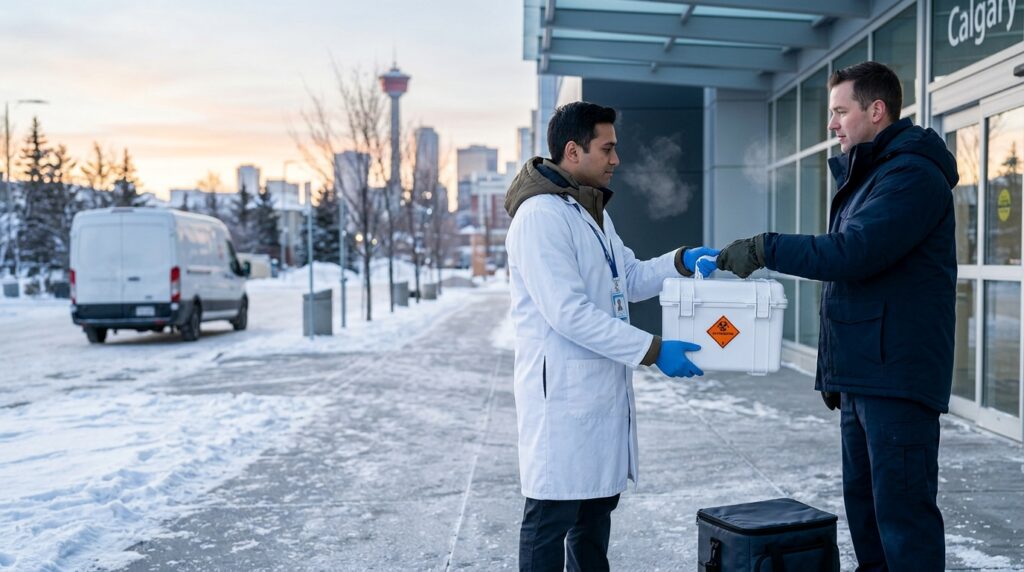
Sending a medical sample or specimen by courier sounds simple until you’re standing at the counter with a tube of blood and a lab deadline. Which box? Which label? Does it need ice?
Get one step wrong and a whole day of results disappears. In Calgary the stakes climb in winter, when a 20 minute drive at -25°C can freeze a tube solid.
This guide covers the full process. You’ll learn how to classify your sample, pack it, label it and book a specimen courier who knows the rules. It works whether you run a clinic or a small lab or you’re a patient returning a kit.
Why medical sample transport needs a plan
A parcel of shoes can sit in a van for six hours and nobody cares. A specimen can’t.
Cells break down. Bacteria grow. Temperature swings change test results. Some samples are only good for a few hours after collection, and the lab clock starts the moment you draw them.
Medical sample transport also carries legal weight. Canada regulates how biological material moves on public roads, and the shipper carries the responsibility for getting it right.
What counts as a medical specimen
A specimen is any material taken from a person or animal for testing. The list is long:
- Blood and serum
- Urine and stool
- Swabs
- Tissue and biopsy samples
- Saliva
- Pathology slides and blocks
Each one has its own handling needs. A urine cup and a frozen tissue sample can’t travel the same way.
Why a regular courier run falls short
Standard couriers batch deliveries. Your driver might make nine stops before yours, and your sample rides along in a hot or freezing cab the whole time.
A dedicated specimen courier drives straight from pickup to the lab. That direct route is what protects the sample. Our post on medical delivery services Calgary clinics and pharmacies trust explains what that looks like day to day.
Know your sample category before you pack
Everything starts with classification. Under Canada’s Transportation of Dangerous Goods (TDG) rules, the person shipping the sample decides which category it falls into. Your courier can’t decide for you.
If you aren’t sure, ask the lab or a qualified safety officer. Guessing is where most trouble begins.
| Category | What it means | Typical examples | Packaging level |
|---|---|---|---|
| Exempt human specimen | Minimal chance of carrying a pathogen | Routine blood chemistry, urine for drug screening | Leak-proof triple packaging with marking |
| Biological substance, Category B (UN3373) | Known or suspected to contain an infectious agent that wouldn’t cause permanent disability or life-threatening disease | Cultures from patients, many diagnostic swabs | Triple packaging with UN3373 mark |
| Infectious substance, Category A | Can cause serious disease in healthy people or animals | Rare. Usually handled by specialist carriers | Certified packaging and special handling |
Exempt human specimens
Most routine lab work falls here. Think cholesterol panels and standard urine tests.
Exempt doesn’t mean careless. Packaging still has to hold liquid inside if the box gets crushed. Many carriers ask for an “Exempt human specimen” marking on the outer box.
Category B (UN3373)
This is the one you’ll see most in pathology delivery. The outer box needs a diamond shaped mark showing UN3373 and the words “Biological Substance, Category B.”
Packaging has to meet a recognized standard (usually called Packing Instruction 650). You can buy approved kits from medical suppliers. Spending $15 on a proper kit beats losing a $400 test.
Category A
Category A shipments are rare and tightly controlled. If you think yours qualifies, call a specialist carrier before you do anything else. Standard medical couriers generally won’t accept it.
Step by step: how to send a medical sample or specimen by courier
Here’s the process I’d follow every time. It takes about 15 minutes once you’ve done it twice.
Step 1: Confirm the rules with the receiving lab
Call the lab first. Ask about the container type and the temperature range. Ask about the maximum time between collection and arrival, and whether they need a requisition form.
Labs such as Alberta Precision Laboratories and Dyna LIFE publish collection guides for their tests. Some tests have a stability window of only a few hours. That window decides how fast you need to move.
Step 2: Collect and label the sample
Use the correct tube or cup. Fill it to the right level because underfilled tubes can skew results.
Label every container with at least two patient identifiers (a full name and date of birth is the common pair). Add the collection date and time. A sample with a missing or smudged label gets rejected on arrival, and then you start over.
Step 3: Use triple packaging
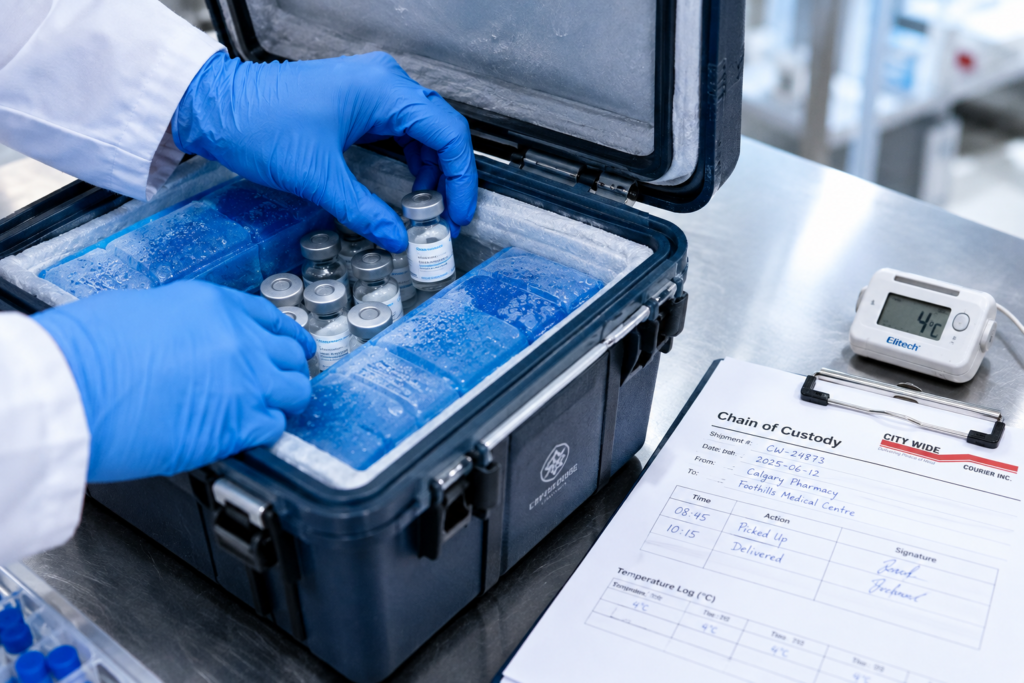
Triple packaging is the backbone of safe medical sample transport. It has three layers:
- Primary container: the leak-proof tube or cup holding the sample.
- Secondary container: a sealed leak-proof bag or box around it, with enough absorbent material to soak up the entire liquid volume.
- Outer packaging: a rigid box that protects everything from crushing.
Put the paperwork outside the secondary container. If something leaks, the forms stay dry and the sample stays clean.
Step 4: Control the temperature
Match the packing to what the lab told you in step 1. The table below shows common ranges.
| Temperature range | Typical use | How to pack |
|---|---|---|
| Room temperature (15 to 25°C) | Many urine and stool samples, some swabs | Insulated box in winter and summer |
| Refrigerated (2 to 8°C) | Many blood tests, cultures, vaccines | Gel packs, with a barrier so tubes never touch frozen packs |
| Frozen (-20°C or colder) | Some serum, tissue and research samples | Frozen packs or dry ice in a vented box |
Dry ice is a regulated dangerous good of its own (UN1845). The box can’t be sealed airtight because the gas needs a way out. Tell your courier when dry ice is inside, and read our list of prohibited items you can’t send by courier in Calgary so nothing else in the box causes a problem.
Step 5: Prepare the paperwork
Fill in the requisition form completely. Include the ordering provider and the tests requested. Add a contact number the lab can call.
Your courier may also need a shipping document depending on the category. Ask when you book.
Step 6: Book a qualified courier
Choose a courier who handles specimens daily. Share the pickup address and the delivery address. Tell them the category and the temperature needs along with your deadline. You can find our phone number and every service on the City Wide Courier.
More on picking one below.
Step 7: Track the delivery and confirm receipt
Ask for a proof of delivery with a name and a time. Then phone or message the lab to confirm the sample arrived intact.
That last call takes 30 seconds. It saves you from finding out three days later that nothing arrived.
Temperature control in Calgary
Calgary weather doesn’t play fair. A Chinook can push the temperature up 20 degrees in a few hours. Then the cold snaps back and a van parked for ten minutes turns into a freezer.
Winter rules I’d follow:
- Never leave a specimen in a parked vehicle
- Use an insulated box even for room temperature samples
- Keep samples away from the cold outer wall of the package
- Check your pickup time so nothing waits on a loading dock
Summer matters too. A black cooler bag on a sunny dashboard can pass 40°C in under an hour. Heat damages samples as fast as cold does.
A good specimen courier carries insulated bags and temperature packs in the vehicle. Ask if they do. If a driver shows up with nothing but a plastic bin, that’s your answer.
Paperwork and labeling that keep samples moving
Labs reject samples for small reasons. A wrong spelling or a missing time is enough.
Keep this checklist near your packing station:
- Patient name and date of birth match the requisition exactly
- Collection date and time are written on the container
- The right marking is on the outer box (UN3373 or the exempt specimen marking)
- Sender and receiver names and phone numbers are on the outside
- Orientation arrows point up for liquid samples
Chain of custody matters if your sample could end up in legal or workplace testing. In that case every handoff needs a signature and a time. Tell your courier before pickup so they bring the right forms.
For official rules, Transport Canada keeps the Transportation of Dangerous Goods regulations on its website. It’s worth a bookmark if you ship samples often.
How to choose a specimen courier in Calgary
Anyone with a van can say they do medical work. A few questions sort the real ones from the rest. Our general guide on how to choose a courier service for your business covers the basics before you get to the medical specifics below.
Questions to ask before you book
- Do your drivers hold current TDG training?
- Do you run direct point to point routes or multi stop routes?
- Can you hold 2 to 8°C for the whole trip?
- Do you provide signed proof of delivery?
- What happens if a sample is delayed or damaged?
A good provider answers these without hesitation. If you get vague replies, keep looking.
Local knowledge matters
Calgary is spread out. A pickup in the northeast and a delivery to Foothills Medical Centre means crossing the city on Deerfoot Trail at the wrong time of day. A driver who knows the routes to the Foothills campus and the Alberta Children’s Hospital and Peter Lougheed Centre can save you 20 minutes a trip.
If you run a small clinic or dental lab or independent practice, our same day delivery for businesses service is built for that kind of rush. Pickups don’t wait for a route to fill up.
Drug trials and compounding pharmacies often need more than a basic run. Our pharmaceutical courier service covers temperature aware and time critical deliveries for clinics and pharmacies and medical labs.
Pathology delivery: moving samples between clinics and labs
Pathology delivery has its own rhythm. Biopsies and tissue blocks and slides often travel from a clinic to an outside pathologist and back again.
Tissue in formalin needs a leak-proof container with enough absorbent material. Formalin is a hazardous liquid and you need to tell your courier it’s inside. Slides need rigid cases so they don’t crack.
Many practices set up a standing route. A driver collects at 3:00 PM every weekday and delivers by 4:00 PM. That predictability cuts down on phone calls and missed cutoffs.
When a result is overdue and a repeat sample has to move fast, see how urgent courier service in Calgary works with direct rush delivery.
Common mistakes that ruin a sample
I see the same errors again and again:
- Skipping the lab call. Every lab has its own rules.
- Using one bag for everything. A single zip bag leaks.
- Putting tubes straight against ice packs. Frozen blood is useless blood.
- Waiting until late in the day. Afternoon traffic and lab cutoffs collide.
- Writing labels in pen on wet containers. The ink runs.
- Forgetting weekend cutoffs. Some labs don’t receive on Saturdays.
Fix those six and you remove most rejections.
What affects cost and delivery time
Prices vary by distance and urgency and the service level you pick. Here’s how the factors play out.
| Factor | Effect on cost | Effect on speed |
|---|---|---|
| Rush or direct delivery | Higher | Fastest |
| Scheduled route | Lower | Predictable |
| Temperature control | Slightly higher | No change |
| Dry ice | Higher | No change |
| After hours pickup | Higher | Flexible |
A scheduled daily run costs less per trip than a one off rush. If you send samples more than twice a week, contact us for a quote on a standing arrangement.
For deliveries outside Calgary, such as a lab in Edmonton or Vancouver, samples may travel by road or air. Air shipments add airline rules and cutoff times. Plan an extra day.
Frequently asked questions
Can I send a medical sample through the regular mail?
Postal services restrict biological material and many items are refused. Check their current rules before you try. A medical courier removes that guesswork.
How fast can a specimen courier pick up in Calgary?
It depends on traffic and distance and how busy the day is. With our same day courier service a driver is usually dispatched right away and pickup often happens within 30 to 60 minutes of your call. Delivery typically follows within 2 to 3 hours depending on distance.
What should I do if a sample leaks in transit?
Don’t open the package. Put on gloves if you handle it. Tell the lab and the courier right away and follow the lab’s instructions. Report the incident so the cause gets fixed.
Who is responsible for classifying the sample?
You are. The person shipping the sample must classify it and pack it to match. Your courier can advise but the legal duty stays with the shipper.
Can an individual book a medical courier or only a business?
Many couriers take bookings from patients and clinics alike. Ask at booking and have the lab’s address and instructions ready.
How long can a sample sit before it spoils?
Some last a few hours and others survive a day or more if kept cold. The lab sets the limit for each test. Ask them for the exact window before you collect.
Final thoughts and next steps
To send a medical sample or specimen by courier the right way, start with the lab’s rules and classify the sample. Pack in three layers and keep the temperature steady. Label it clearly and book a driver who handles specimens every day.
My recommendation is simple. Build a one page checklist for your practice and keep it at the packing table. Pick one trusted courier and use them every time so drivers learn your routine.
Ready to move a sample? Book medical courier with City Wide Courier or call (403) 246-8349 and we’ll dispatch a driver.