
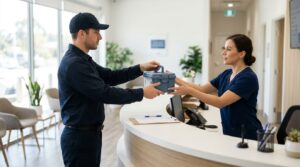
A dental lab courier has one job. Get the work to the lab and the finished case back to your chair without anything warping or going missing.
That sounds easy. It’s also the step that quietly causes remakes, bumped patients and tense phone calls on a Friday afternoon.
I’ll cover how to pack impressions and prosthetics, what goes on the paperwork, which delivery speed fits which job and what to look for in a Calgary courier.
Why dental lab work needs its own kind of courier
Most deliveries are one-offs. A dental lab run is a standing route between your practice and a lab, repeated every week.
Same two addresses. Same small boxes. Very different stakes from a parcel of paperbacks.
Everything in that box was made for one patient’s mouth. If it arrives warped or goes missing, no one can grab a replacement off a shelf.
A remake costs more than the delivery
When an impression arrives distorted the lab can’t fix it. The patient comes back to have it retaken and you spend chair time twice on one case.
The lab’s schedule slips with it. So does your next appointment.
I’d say the courier is the cheapest line item in the whole case. It’s also the one people think about least.
What a lab to practice courier carries
A typical run might hold:
- Impressions in alginate, PVS or polyether
- Bite registrations and stone models
- Crowns, bridges and veneers
- Dentures and try-ins
- Aligners, retainers and night guards
- Small implant components
Each one fails in its own way.
If you’re sending clinical samples such as blood or tissue, that’s a different job. Our pharmaceutical courier service handles time-critical medical deliveries for Calgary clinics, pharmacies and medical labs.
What goes wrong in transit
Dental materials are fussy. This table shows where cases tend to fall apart.
| What you’re sending | What goes wrong | What helps |
| Alginate impression | Dries out and shrinks | Sealed bag and a fast delivery |
| Polyether impression | Absorbs water and swells | Skip the long soak and follow the maker’s guidance |
| PVS impression | Gets crushed in a loose box | Rigid tray packed so it can’t shift |
| Wax bite or try-in | Softens in a warm vehicle | Keep it cool and send it direct |
| Porcelain crown or veneer | Chips when pieces knock together | A padded compartment for each piece |
| Denture or partial | Cracks if dropped | Rigid case with foam inside a closed box |
| Implant components | Vanish at the bottom of a bag | Small labelled bag inside a closed container |
Heat, cold and Calgary weather
Calgary doesn’t do mild. A van sitting at -25 C in January and a closed car baking at 30 C in July both hurt dental work.
Wet materials like alginate hold water. Freezing damages them. Wax softens in a sun-baked car.
So ask any courier how they handle both extremes. Direct delivery helps because fewer hours in a vehicle gives the weather less time to get at your work.
How common materials differ in transit
Each material has quirks. Check the maker’s instructions for your exact product because brands vary.
Alginate
Alginate is the one to hurry. It’s mostly water so it loses or gains moisture quickly in open air.
Seal it and book a fast service. Ask your lab how long they’ll accept before pouring.
PVS
PVS usually holds its shape far longer than alginate. That makes it forgiving on next-day runs.
It can still be crushed or bent. Support the tray so it can’t flex.
Polyether
Polyether absorbs water. A long soak in disinfectant can change its dimensions.
Use the maker’s disinfection method and keep the exposure short.
Stone models and bite registrations
Stone models are heavy and chip at the edges. Wrap each one separately and lay it flat.
A wax bite needs a cool spot. A bite in a rigid material needs padding so it doesn’t snap.
How to pack impressions for pickup
The Scottish Dental Clinical Effectiveness Programme says the dentist is responsible for cleaning and disinfecting impressions and appliances before they go to the lab. A Calgary practice follows its own infection prevention policy and regulator standards. Your lab will have a receiving policy too, so ask for a copy and match your routine to it.
The packing routine
- Rinse the impression under cold running water straight after you take it out of the mouth. Keep going until it’s visibly clean.
- Check what the material can handle. Polyether, for one, distorts when soaked.
- Disinfect with a product suited to that material. Follow the maker’s contact time.
- If you use a spray, bag the impression first and spray inside the sealed bag. That keeps the fumes out of your lungs.
- Rinse again if the disinfectant maker says to. Then seal the item in a clean, leak-proof bag.
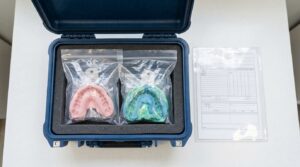
- Put the bag in a rigid container with enough support that it can’t slide around.
- Keep the lab script in its own sleeve. Wet impressions and paper don’t mix.
A packed dental transport box with sealed bags and a separate paperwork sleeve
Paperwork that saves you a phone call
The lab needs to know how each item was processed, so write it down.
What the lab script needs
- A case number or patient ID
- Material, shade and due date
- A disinfection note with the time, method and your initials (something like “Disinfected 10:15 a.m., spray, rinsed, AK”)
- A phone number someone will answer
What goes on the outside of the box
- Practice name and pickup address
- Lab name and delivery address
- A fragile label
- A contact number
Patient names stay off the outside. A case number tells a stranger nothing.
Packing finished prosthetics for the trip back
Many labs return finished work clean but not sterile. Plan to disinfect or sterilize it under your own protocol before it goes near a patient’s mouth.
Check the lab’s note on how the work was handled. If you can’t find one, call.
Here’s how I’d pack the return leg:
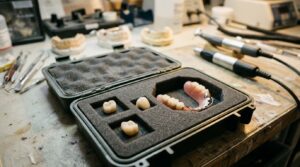
- Give each crown or veneer its own padded compartment. Never let two touch.
- Put dentures and partials in a rigid case, then inside a closed box.
- Keep the model with its case. A crown without its model is half a job.
- Use foam inserts. Loose bubble wrap lets hard pieces rattle.
Aligners, retainers and night guards
These are light and flat so they slip out of oversized packaging. Use a small rigid case and tape it inside the box.
Timing the return so the patient isn’t waiting
Say a fitting is booked for 10:00. Ask the lab when the work will be ready.
Then book a timed courier delivery for 9:00 so the case reaches you before the patient does. Calgary traffic doesn’t care about your schedule, so build in a buffer.
Finished crowns and a partial denture in a foam-lined case on a lab bench
Matching delivery speed to the job
Different cases need different speeds. Here’s how I’d split them.
| Service | Best for | Dental example |
| Same-day courier | Daily lab runs and urgent try-ins | Morning impressions at a Calgary lab by afternoon |
| Next-day delivery | Planned, routine work | Pickup at 4:30 p.m. and the lab has it first thing |
| Hot shot delivery | A dedicated vehicle for a rush job or a long haul | A remake needed tomorrow or a lab in Edmonton or Red Deer |
| Timed delivery | Appointment deadlines | Crown at your door by 9:00 for a 10:00 patient |
In most cases we pick up within 30 to 60 minutes of your call. Delivery usually follows within 2 to 3 hours, depending on distance.
Our regular hours are Monday to Friday, 8:00 a.m. to 5:00 p.m. For after-hours emergencies, call (403) 246-8349 and we’ll do our best.
We cover Calgary plus Airdrie, Cochrane, Chestermere and Okotoks. Hot shot runs go anywhere in Alberta.
Dental impression delivery, from booking to drop-off
A same-day run is short when you plan it. Here’s an example timeline for one case (real times depend on distance and traffic).
| Time | What happens |
| 9:40 a.m. | You take the impression, then rinse, disinfect and bag it |
| 10:05 a.m. | You phone (403) 246-8349 or send the quote form with both addresses |
| 10:45 a.m. | The driver arrives and collects the sealed box |
| 12:15 p.m. | The lab receives it and the driver gets a signature |
| 12:30 p.m. | The lab checks the case and confirms it can go ahead |
Call the lab before the first run
A 5 minute call saves weeks of small confusion. Ask the lab four things:
- Their receiving hours and the cutoff for same-day cases
- Which door the driver should use and who signs
- How they want disinfection recorded
- Who to call when a case looks wrong
Keep the box somewhere sensible until pickup
Room temperature is the target. Keep it away from a sunny window and a radiator.
Wet materials dry out and wax softens, so a box on the sill is a bad idea. A shelf behind the front desk works fine.
Five checks before the driver arrives
- The item is rinsed, disinfected and sealed
- The lab script sits in its own sleeve
- The box is closed and labelled on the outside
- The box is at the front desk and away from the window
- The lab knows a case is on its way
Digital impressions and the courier
Intraoral scanners send a file to the lab in minutes. No driver needed for that part.
The physical work still moves. Printed models, try-ins, bite registrations, crowns and dentures all travel between two buildings.
I’d expect a scanner-heavy practice to send fewer impressions and receive the same amount of finished work. So the return-leg packing tips above matter just as much.
Privacy and patient information
Patient information is health information in Alberta. A lost box is a privacy problem as well as a clinical one.
A few habits keep risk low:
- Put a case number on the outside and keep names inside
- Keep the lab script in its own sleeve in the box
- Get a signature at the lab so you know a named person received it
- Follow your practice’s privacy breach process if a box goes missing and call us the same day
Picking a dental lab courier in Calgary
Any courier can drive a box across town. A good dental lab courier treats the box like it holds someone’s treatment, because it does.
Ask these questions before you commit:
- Are the drivers licensed, insured and in uniform?
- Is the run direct, or does your box ride along on 6 other stops?
- Can you get a record of who signed and when?
- Can you call a real person who knows your account?
- Will they follow your handling notes?
Why a direct run suits fragile work
On a shared route your box rides along while the driver makes other stops. That adds time in the vehicle and time for the weather to do its work.
A direct run goes from your door to the lab’s door. For alginate, wax and anything freshly made I’d pick direct every time, even when a shared run costs a little less.
Next-day routes are fine for stable materials and finished work that isn’t urgent. Match the service to the case.
Records and signatures
Records matter more than people expect. Our guide to proof of delivery explains what you should get back after every drop.
We’ve been running Calgary deliveries since 1986. Our write-up on medical delivery services Calgary clinics trust covers what any clinic should expect from a medical courier.
Setting up a standing route
Dental runs repeat, so build a routine once and stop rethinking it.
- Pick a pickup window that suits your clinic schedule.
- Name one person who hands the box to the driver.
- Choose a fixed spot at the front desk for outgoing cases.
- Agree with your lab on a drop-off spot and a contact name.
You don’t need an account to start. Call or use the online quote form.
If dental runs turn weekly, an online account gives you order history. That record helps when a lab says it never got a case.
What affects the price
I can’t give you one number because dental runs vary a lot. These factors move the price:
- Distance between your practice and the lab
- Speed (same day, next day or hot shot)
- Vehicle size
- Whether the driver waits or returns with finished work
Request a quote and tell us the route. We reply within the hour during business hours.
What to do when a case arrives damaged or late
Same-day phone calls fix most of these. A week later, no one remembers which door the driver used.
- Photograph the box and the contents before anything moves.
- Note the condition on the delivery receipt when you sign.
- Call the sender and the courier the same day while details are fresh.
- Let the lab decide whether to proceed or ask for a retake.
- Keep your disinfection record with the case file.
A clear record also helps you work out whether the problem started in the chair, in the packing or on the road.
Mistakes I’d fix first
- Skipping the disinfection note. The lab then has to treat your impression as contaminated.
- Putting the lab script inside the wet bag. Paper turns to mush.
- Using a padded envelope. Crowns and models need a rigid box.
- Missing the pickup cutoff. A late booking turns a same-day case into a next-day one.
- Writing the patient’s name on the outside. Use a case number.
- Leaving a box in a parked vehicle. Heat and cold both do damage.
Book your next lab run
A good dental lab courier gets impressions to the lab undamaged and finished work back before your patient sits down. Disinfect and label every item, then pack it rigid and pick a speed that fits the case.
Pack it right and the rest is easy. Book a dental lab courier or call (403) 246-8349.
Frequently asked questions
Will a courier take impressions that haven’t been disinfected?
Disinfect first. Your lab expects it and your infection control policy likely requires it.
How fast can a driver reach my practice?
In most cases within 30 to 60 minutes of your call during business hours. Distance and traffic change that.
Do I need an account to book a lab run?
No. Phone (403) 246-8349 or use the online form. We take cash, Visa and Mastercard.
How long can an alginate impression wait?
Not long. Alginate is the most time-sensitive material you’ll send. Check the maker’s instructions and ask your lab how soon they need it.
Can the courier bring the finished case back the same day?
Often yes. Ask the lab for a ready time and book the return pickup from the lab.
Do you offer a dental courier service in Calgary?
Yes. We run dental courier deliveries across Calgary plus Airdrie, Cochrane, Chestermere and Okotoks. Hot shot runs go anywhere in Alberta.
Call (403) 246-8349 to set up your first pickup.