
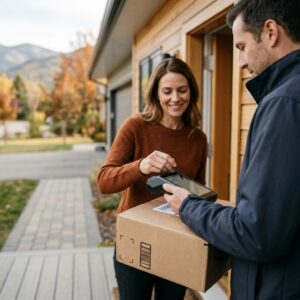
A parcel gets marked “delivered.” Two days later the customer emails to say it never arrived.
What can you show them? A one-word tracking status proves nothing. A proof of delivery courier gives you a name and a signaal ture with a timestamp and often a photo of the parcel at the door.
Proof of delivery (POD) is the courier’s record that your parcel reached the right place at a specific time and that a specific person took it. The rest of this guide is about making sure that record is strong enough to settle an argument.
What proof of delivery actually is
POD is evidence. The courier creates it at the moment of drop-off.
A good one answers 4 questions: what was delivered, where, when and to whom. Miss any of them and the record has a hole in it.
POD vs a tracking status
A tracking status says “Delivered.” That’s the courier’s claim.
POD is the proof behind the claim. It might be a signature on the driver’s handheld or a photo of the parcel on the doorstep or a one-time code the recipient read out loud.
Plenty of couriers show the status for free and keep the proof in a back office. You find out which kind you have when something goes wrong, which is a rotten moment to find out.
Who needs it
Anyone shipping parcels that cost real money to lose. Online shops and parts suppliers do. So do law firms sending original documents and companies posting laptops to remote staff.
My rule of thumb: if “I never got it” would cost you more than the parcel (refund plus replacement plus an annoyed customer), get POD.
Banks care too. When a cardholder files an “item not received” dispute, the bank asks the merchant for delivery evidence. A bare status rarely wins that one. Stripe looked at evidence packets from one million disputes and found that for physical goods, delivery confirmation plus a GPS map plus a signature went with a 44 percentage point higher win rate.
How a driver actually captures POD
Knowing the flow helps you spot weak records.
The driver arrives and scans the parcel barcode. The app logs the time and GPS position. Then it prompts for whatever proof the job requires: a signature, a photo, a PIN or all of them. The driver taps “complete” and the record syncs to the courier’s system.
With electronic POD that sync takes minutes. With paper, someone has to scan the slip later.
Here’s where it breaks:
- The phone has no signal, so the record queues and uploads later (the timestamp may reflect the upload instead of the drop)
- The driver taps “delivered” from the van before walking to the door
- A rushed driver grabs a signature and skips the printed name
- The photo gets taken from the sidewalk instead of at the door
Many weak PODs trace back to one of these. So ask any POD courier you’re considering a direct question: is the timestamp when the driver tapped complete or when the record reached your system?
Types of proof of delivery
Couriers use 5 main methods. They aren’t equal.
Signed proof of delivery
The recipient signs on paper or on the driver’s screen. Signed proof of delivery is the oldest method and still the strongest for contracts and high value goods.
Make sure the driver also records a printed name. A squiggle on its own proves very little.
Photo proof of delivery
The driver photographs the parcel where they left it. Photo proof of delivery suits doorstep drops and recipients who aren’t home.
A good photo shows the parcel plus enough background to identify the address (a door number or a distinctive porch). A timestamp and GPS tag make it much stronger.
Photos don’t show who picked the parcel up. For anything expensive that gap matters.
Electronic POD (ePOD)
With ePOD the signature or photo is captured on the driver’s phone and sent to you within minutes. The data is the same as paper. You just get it faster, with a timestamp that’s harder to fudge.
Paper PODs can take days to find and scan. If you ship daily that delay adds up fast.
PIN or OTP confirmation
The recipient gets a code by text or email and reads it to the driver. It proves the person who expected the parcel was standing there.
Use it for age restricted items and prescriptions.
Scan and GPS data
Every parcel gets scanned at delivery. The scan carries a time and a location.
This is supporting evidence. It puts the driver near the address and says nothing about who got the parcel. Treat it as backup.
| Type | What it proves | Best for | Weak spot |
|---|---|---|---|
| Signed | A named person accepted it | Contracts and expensive goods | Illegible signatures |
| Photo | The parcel was at the address | Everyday parcels and doorstep drops | Shows no recipient |
| ePOD | Signature or photo, delivered fast | Daily shippers | Courier needs the tech |
| PIN or OTP | The expected person was present | Age restricted and sensitive items | Recipient needs a phone |
| Scan and GPS | The driver was near the address | Backup evidence | No recipient details |
What a good POD includes
Here’s the checklist I’d hold any courier to.
The must-haves
- Tracking or consignment number. It ties the record to your shipment.
- Date and exact time. “Tuesday” doesn’t cut it. You want 2:14 pm.
- Delivery address as delivered. The booked address and the actual one sometimes differ.
- Recipient’s printed name, next to the signature.
- Signature or PIN confirmation. One of them has to be there.
- Driver name or ID. Useful when you need to ask what happened.
- Delivery exceptions. Left with a neighbor, handed to reception or put in a safe place. The record should say so.
The nice-to-haves
- A photo of the parcel in place
- GPS coordinates of the drop
- Condition notes like “box dented” or “seal intact”
- A note that ID was checked (for restricted items)
Why the printed name matters
Signatures are hard to read. A printed name gives you someone to follow up with.
Without it you can’t tell a customer “your partner signed for it at 11:40.” With it you can.
If the POD says “left with neighbor,” ask for the house number. That one detail ends many disputes in a single phone call.
Red flags in a proof of delivery
- A signature with no printed name
- A delivery time that disagrees with the tracking events (POD says 2:10 pm while tracking says 4:45 pm)
- A photo of a door or a street with no parcel in it
- A photo that looks like a different address
- “Delivered” with nothing behind it
- A courier that takes days to produce the record or can’t produce it at all
Any one of these is a reason to push back. Two or more is a reason to rethink the courier.
A POD that is only a status line, with no name or photo or signature, is weak evidence.
Which POD fits which shipment
| Shipment | Best POD |
|---|---|
| High value or contractual goods | Signed ePOD with printed name |
| Standard online orders | Photo POD with timestamp |
| Age restricted or sensitive items | PIN or OTP, or a signature with ID check |
| Unattended or contactless drops | Photo POD with GPS |
| Legal documents | Signed POD with ID check |
Most businesses mix several of these. Ask your courier to set rules by shipment value so drivers don’t have to guess.
POD for different kinds of business
Online shops
Photo POD with a timestamp covers most orders. Add a signature requirement above a value threshold (say $150) so your expensive orders get the stronger proof.
B2B and parts suppliers
Payment terms often start at delivery. A signed ePOD with a printed name attaches straight to the invoice and answers the question your customer’s accounts team will ask.
Documents and medical items
A legal courier job and a pharmaceutical courier job both come down to identity and chain of custody. Lab samples belong in the same bucket. Use a PIN or an ID checked signature and ask for condition notes. For temperature sensitive items ask whether the courier logs handoff times.
Why POD matters for insurance and claims
A damaged or lost parcel triggers a claim. Claims ask for evidence of what happened and when.
Condition notes on the POD carry weight because someone wrote them at the door. If you’re the receiver, photograph the box before you open it. Write “damaged” on the slip before you sign, because a clean signature can weaken a claim later.
Rules vary by courier and country. Read your terms before you need them.
Tricky delivery situations and what the POD should say
Most parcels land with a signature and nothing interesting happens. The odd ones are where the record earns its keep.
Left with a neighbor
The POD should carry the neighbor’s name and house number. Without them the courier has proved delivery to no one in particular. If your customer doesn’t know the neighbor, ask for the driver’s notes and go from there.
Safe place drops
A photo is the only real evidence here. It should show the parcel in the spot the customer chose (behind the planter or inside the porch) with the door number in frame. A proof of delivery courier worth hiring takes that shot every time without being asked.
A parcel photographed in some anonymous corner proves very little.
Locked building or reception desk
Reception staff sign for dozens of parcels a day. Ask the courier for the name of the person who signed and the exact time. Many buildings keep their own log. The courier can often point you to it.
No one home and no photo
If the driver left without a signature or a photo, the record is just a status line. Treat it as a failed delivery. Ask the courier for a redelivery or a claim under your terms.
How to get proof of delivery from your courier
- Grab the tracking or consignment number.
- Check your account portal first. Many couriers publish PODs there.
- If it’s missing, contact support and ask for the signed copy or the photo. Use those words. “Confirm delivery” just gets you the status again.
- Ask for the delivery time and the driver’s scan data too.
- Move fast. Couriers keep POD records for a limited time and the window varies.
When the courier stalls
Put the request in writing. Email beats a phone call because it leaves a timestamp.
Quote your tracking number and the delivery date. Ask for 4 things: the signature or photo, the printed name, the delivery time and the GPS location. Set a deadline (2 business days is reasonable).
If you ship often, ask for automatic PODs by email or a direct feed into your order system. Then you never chase one again.
How to pick a proof of delivery courier
Price gets most of the attention. POD quality deserves more of it.
Questions to ask before you sign up
- Which POD types do you capture as standard?
- How fast do I get the record, minutes or days?
- Is there a charge for signature or photo options?
- How long do you keep records?
- Can I get PODs delivered automatically?
- What happens when a driver skips the signature?
Ask to see a real sample too. Five minutes with an actual POD tells you more than a sales page.
Does POD cost extra?
It depends on the courier. Some include signature and photo capture in the base rate. Others charge per parcel for signature options or add a fee for pulling old records.
Get the answer in writing before you ship. A courier that won’t quote POD terms is waving a warning flag.
What the contract should say
Look for a stated turnaround on POD requests and a stated retention period. Both should be actual numbers. “Promptly” and “a reasonable period” don’t count.
Check liability limits too. Many couriers cap payouts per parcel, so a great POD only helps if the cap covers what you shipped.
Mistakes that weaken your POD
- Accepting “Delivered” as proof
- Asking for POD months later, after the courier has purged it
- Skipping photo capture on expensive parcels because it “slows drivers”
- Letting high value parcels go out with no signature requirement
- Never checking a sample POD before committing
- Ignoring a time mismatch between the POD and the tracking
The fix for all of these is the same. Look at real PODs early.
What a dispute looks like with a good POD
Here’s how this tends to go.
A customer says the parcel never came. You pull the POD. It shows a printed name and a signature and a 3:42 pm timestamp and a photo of the parcel on the porch with the door number visible.
You send it over. Most disputes end there because the customer recognizes the name (a roommate or a spouse) or finds the box.
Now run the same dispute with a bare status. You write to the courier and wait 5 days. The customer files a chargeback. You lose the sale and the parcel.
A strong POD won’t win every dispute. Some customers lie and some drivers skip steps. But it changes the odds a lot. It also makes the honest cases easy to close.
How long to keep your PODs
Couriers delete records on their own schedule. Ask for theirs.
Download PODs for high value shipments right away. For everything else a monthly export is enough.
Keep them at least as long as your refund window plus any dispute window runs. For tax or accounting records ask your accountant. I won’t guess at the legal minimum for your country.
FAQs
Can anyone sign for a parcel?
Usually whoever is at the address can sign unless you’ve set restrictions. If you need a specific person, ask for named recipient or ID checked delivery.
Does the recipient get a copy of the POD?
Generally the sender gets it. Some couriers also email the receiver a delivery notice with a photo. Ask yours what it sends.
What if the customer says the signature isn’t theirs?
Compare it with the printed name and the delivery time. Someone else at the address may have signed. Ask the courier for the driver’s notes and the GPS data.
Will a photo POD hold up in a chargeback?
It helps a lot when it shows the parcel at the right address with a timestamp. No document guarantees a win because each bank and card network makes its own call.
What’s the difference between POD and proof of shipment?
Proof of shipment shows the courier collected the parcel. POD shows it arrived. You want both for a complete trail.
Do international shipments come with POD?
Often they do. Quality depends on the last mile carrier in the destination country, so ask which partner delivers and what they capture. Some destinations produce thinner records than others.
Get proof you can actually use
A good proof of delivery courier hands you evidence you can forward to a customer or a bank. For anything that matters look for a printed name and a signature or PIN plus an exact time. Add a photo when the parcel is going to a doorstep.
Test a sample POD before you commit. Put turnaround times and retention periods in writing.
At City Wide Courier every delivery comes with a timestamped signature and GPS tracking from pickup to drop-off. Get a free quote and we’ll send a price back in minutes.