
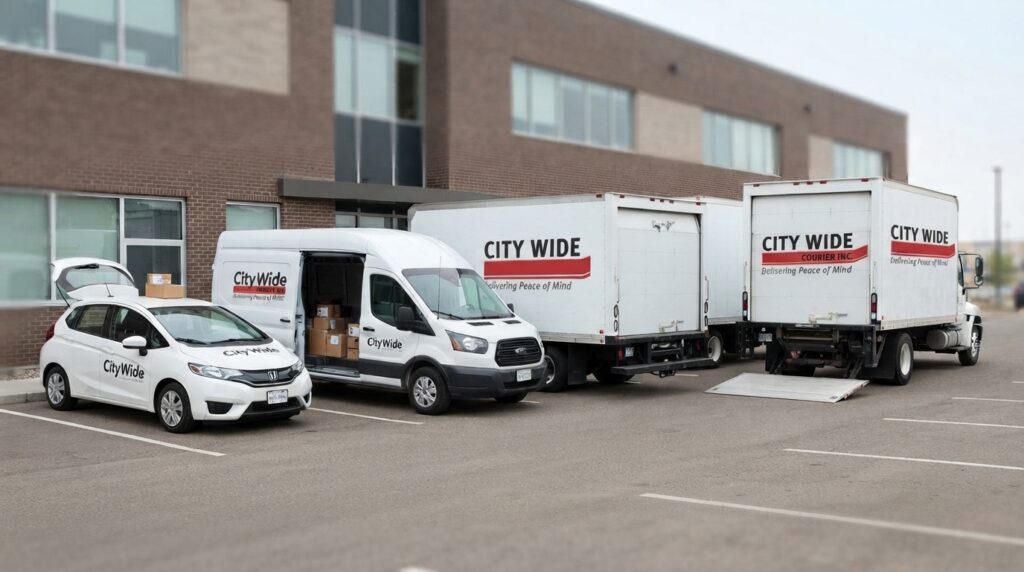
You’ve got something to ship and the quote form wants a vehicle size. Where do you even start?
This courier van size guide answers that in plain numbers. You’ll get cargo space, weight limits, pallet counts and a clear idea of which vehicle matches your load.
Pick too small and the driver leaves boxes behind. Pick too big and you pay for empty air. (We’ve seen both. Neither ends well.)
Courier van size guide: the quick table
Start here if you’re in a hurry. Find the row closest to your load.
| Vehicle | Typical cargo space | Rough max load | Standard pallets | Best for |
|---|---|---|---|---|
| Car | 12 to 18 cu ft (trunk) | 300 to 500 lb | 0 | Envelopes, legal documents, 1 or 2 small boxes |
| Cargo van | 247 to 487 cu ft | 3,700 to 5,100 lb | 2 to 4 | Multiple boxes, trade supplies, small furniture |
| Cube van (12 to 16 ft box) | 600 to 800 cu ft | 3,000 to 5,000 lb | 4 to 8 | Appliances, sofas, floor-loaded pallets |
| 5-ton truck with power tailgate | 1,000 to 1,500 cu ft | 8,000 lb and up | 8 to 12 | Heavy pallets, equipment, store restocks |
These are typical figures. Every vehicle differs a little, and a high-roof van holds far more than a low-roof one. Treat the table as a starting point.
If your load sits close to a limit, go up one size. The price gap between two vehicle classes is often smaller than the cost of a second trip.
Still unsure? Call dispatch at (403) 246-8349 and describe what you’ve got.
Which van size fits? Start with three numbers
Three measurements decide the answer: dimensions, weight and floor space.
Length, width and height
Measure the longest, widest and tallest piece. Then compare each one to the cargo area and the door opening. (The next section covers doors in detail.)
Wheel wells also eat into the floor width. A cargo van that looks 5 feet wide at the walls is closer to 4.5 feet between the wells.
Weight
Weight stops more loads than size does. Every vehicle has a payload limit, which is what it can legally carry on top of its own weight.
Ford’s figures show how much that varies. A Transit 250 cargo van carries about 4,085 lbs while the Transit 150 sits at roughly 3,685 lbs. The best case on the 2026 Transit is 5,103 lbs, and that’s a heavy-duty extended van with dual rear wheels. Build Your New Vehicle in The Showroom Configurator +2
Count the driver and any shelving too. The weight cheat sheet further down shows how fast common goods eat that limit.
Pallets and floor space
A standard pallet is 48 by 40 inches. Hold that number in your head.
Cargo vans usually fit 2 to 4, depending on length. Cube vans have a flat floor with no wheel wells to work around, so they pack pallets better.
Height counts here too. Stacked pallets need headroom, and a low-roof van gives you less of it.
Vehicle by vehicle: what each one carries
Car
A car works for paper, small boxes and anything you’d carry by hand. Think contracts, samples, keys, a laptop in its box.
For a single small package, a car is the cheapest and quickest way to go. Our parcel delivery in Calgary service covers this size all day long.
Three medium boxes and a rolled-up rug is van territory.
Cargo van

The cargo van is the workhorse of courier fleets. It handles most business deliveries that are too big for a car and too small for a truck.
Size varies a lot inside this one category. Cargo volume on a 2026 Transit 250 runs from about 247 cu ft in the low-roof short version up to 487 cu ft in the high-roof extended one. That’s nearly double. kbb
So “cargo van” alone doesn’t tell a driver much. Tell us the actual dimensions and we’ll send the right one. You can also check specs on the Ford Canada Transit page.
Callout: Transit-style cargo van interior at a glance
- Cargo volume: 247 cu ft (low roof, regular length) to 487 cu ft (high roof, extended)
- Outside height: low roof about 82 to 83 in, medium roof about 99 to 101 in, high roof about 110 in
- Inside standing height: roughly 4.5 ft (low), 6 ft (medium), 6.5 to 7 ft (high)
- Width between wheel wells: about 54 in
- Payload: about 3,700 to 5,100 lb depending on model
- Pallets: 2 to 4, standing on the floor in a single layer ford
TOP-DOWN VIEW: CARGO VAN FLOOR (not to scale)

 CAB | [ PALLET 1  40" x 48" ] [ PALLET 2  40" x 48" ] | REAR DOORS
     |  wheel well bump on each side, about 54" clear   |
Read it like this. Pallets sit lengthwise down the van with the 40-inch side facing across. The wheel wells pinch the width, so a pallet wider than about 54 inches won’t sit flat.
Cube van
A cube van is a cab with a square box bolted behind it. Boxes run roughly 12 to 16 feet long.
The inside is a clean rectangle. That makes it great for furniture, appliances and floor-loaded pallets, because nothing curves into the space.
Most people who search for a “Luton” are really looking for this.
Callout: cube van interior at a glance
- Box length: roughly 12 to 16 ft
- Box width: about 7 ft inside (varies by builder)
- Box height: about 6.5 to 7 ft inside
- Rear opening: usually a roll-up door close to full box width
- Floor: flat with no wheel wells in the cargo area
- Pallets: 4 to 8 depending on box length and weight
5-ton truck with a power tailgate
Our fleet includes five-ton trucks with power lift tailgates. That tailgate is the feature that matters.
Heavy pallets and machinery go on the lift and ride up to floor height. No ramps and no 3 people straining.
If your load is one big, valuable item that can’t share space, ask about hot shot delivery in Calgary. The vehicle carries only your freight.
Luton vs Transit Courier: what the names mean in Calgary
If you found us by searching “Luton vs Transit Courier,” you’re probably using UK terms. Both are common over there. Neither is a standard name here.
A Luton is a box van with a bump over the cab for extra loading space. A Transit Courier is Ford’s compact small van.
Here’s how they translate to what we run.
| UK name | Rough size | What it’s like in Calgary |
|---|---|---|
| Transit Courier | About 90 to 105 cu ft, 1,100 to 1,300 lb payload | A car or small compact van |
| Transit (full size) | 247 to 487 cu ft | A cargo van |
| Luton | Roughly 530 to 700 cu ft, about 2,200 lb payload | A cube van |
The comparison is rough, since UK and Canadian vehicles differ in weight rules and box design. The useful part is the size class. Match your load to that class and you’ll land on the right booking.
Floor dimensions vs door clearance
Inside space gets all the attention. The opening you have to push the load through is smaller.
A load fits only if it clears the tightest point on its path. That could be the pickup doorway or the van’s door.
Rear doors
Rear doors are the widest opening on a cargo van. Long items, pallets and furniture all go in here.
Height is the catch. A low-roof van has a short rear opening, so tall crates may fit inside once loaded but never get through the door upright. Measure the load’s height against the opening, not the ceiling.
Add 1 to 2 inches of margin on every side. A crate that’s exactly the opening size is stuck.
Side doors
Most cargo vans have a sliding side door too. It’s handy for boxes and shelving, since the driver loads without walking to the back.
The opening is narrower than the rear one though. Anything over about 4 feet wide, or any pallet, belongs at the rear. Long pieces like pipe or lumber slide in best through the back.
Cube van and truck doors
A cube van usually has a roll-up door at the rear, close to full box width. That’s one reason furniture loads easily.
Some boxes also have a side door, but plenty don’t. Ask when you book if your pickup spot only allows side access.
Quick door check
- Find the narrowest opening between your load and the vehicle.
- Measure width and height of that opening.
- Compare to the load with a 1 to 2 inch margin.
- If it’s tight, tilt the load on its side and measure the diagonal. Some pieces only pass at an angle.
If you’re close, send us the numbers. We’d rather reroute a vehicle than watch a sofa jam in a stairwell.
Van dimensions for delivery: how to measure your load
Most quotes go sideways because someone eyeballed the load. Five minutes with a tape measure fixes that.
- Measure the longest item. If it’s over 8 feet, say so right away.
- Measure the widest and tallest item, plus any doorways it has to pass through at pickup.
- Count the pieces. Twelve boxes and 1 big crate load differently.
- Weigh it or estimate. Check shipping labels or product spec sheets.
- Note whether items can be stacked. Fragile freight usually can’t.
Take a photo of the whole load too. Dispatchers read photos faster than descriptions.
Weight cheat sheet: what a pallet actually weighs
Volume is easy to judge by eye. Weight isn’t. This is where this courier van size guide earns its keep, because a load can fit a van perfectly and still be too heavy for it.
A wooden pallet weighs about 40 lb by itself. Add that to every pallet.
| Pallet of… | Typical loaded weight |
|---|---|
| Retail apparel in boxes | 300 to 800 lb |
| Small boxed appliances | 600 to 1,200 lb |
| Lumber (2×4 bundles) | 1,500 to 2,500 lb |
| Paper and printed material | 1,800 to 2,400 lb |
| Bottled water or canned goods | 1,800 to 2,500 lb |
| Drywall | 2,000 to 3,000 lb |
| Bagged concrete or mortar | 2,500 to 3,500 lb |
| Ceramic tile | 2,500 to 3,500 lb |
These are typical ranges. Your pallet may be lighter or heavier, so check the label.
The math is simple: (weight per pallet × number of pallets) + pallet weight + packaging.
Here’s a real-feeling example. 3 pallets of tile at 3,000 lb each is 9,000 lb before the pallets themselves. A cargo van tops out around 5,100 lb, and a cube van around 5,000. That load needs a 5-ton truck.
Now a lighter one. 4 pallets of boxed retail clothing at 600 lb each is 2,400 lb. That fits comfortably in a cube van, and an extended cargo van could handle it if the floor space works.
When weight and volume point to different vehicles, weight wins.
Loading equipment: what you need at pickup and drop-off
The van is only half the job. Someone has to get the load on and off it.
| Equipment | What it handles | Limit |
|---|---|---|
| Hand truck | Boxes, small appliances | Most handle 400 to 600 lb |
| Pallet jack | Pallets on a flat surface | Typically 5,000 lb or more |
| Power lift tailgate | Pallets and heavy items at ground level | Raises load to truck floor height |
A hand truck covers most box loads. It stops being enough when a single item tops about 150 lb or the load needs lifting more than a couple of feet.
A pallet jack moves pallets along the ground. It can’t lift one into a vehicle. Without a dock, you need a tailgate.
Here’s when a liftgate becomes necessary:
- Any pallet with no loading dock at pickup or delivery
- Any single item over about 150 lb with no dock
- Anything on a street or parking lot where the truck floor sits well above the ground
Floor height matters too. A cargo van floor sits near 2 feet off the ground. A cube van and a five-ton truck sit higher, and the five-ton’s power tailgate bridges that gap.
Tell us when you book whether either address has a dock and whether anyone can help load. We’ll confirm what the driver can handle.
How your service type changes the van
Van size is half the decision. The other half is how the delivery runs.
Same-day: Speed matters most here. Our same-day courier service in Calgary matches the closest vehicle that fits your load. If you give us accurate dimensions up front, pickup happens faster.
Hot shot: A hot shot delivery means a dedicated vehicle with only your freight on board. No other stops and no shared loads. Size is yours to choose, which makes sizing mistakes more expensive. Our guide on how to choose a hotshot courier service covers what to ask before booking.
Parcel: Boxes and small freight usually ride in a car or cargo van. If you’re sending lots of small items on a schedule, parcel delivery is built for exactly that.
Common sizing mistakes
The same few errors show up again and again.
- Ignoring weight. The load fits but the van is overloaded.
- Forgetting the door. The item fits inside and still won’t go in.
- Counting on stacking. Fragile or oddly shaped freight can’t be stacked, so floor space runs out fast.
- Trusting “about a pallet.” Pallets vary in height and overhang. Give us the real numbers.
- Booking a car for “a few boxes.” A few can turn into 8 once they’re measured.
Most of these come down to one thing. People guess the load instead of measuring it.
Common loads and the van that fits
| Your load | Van that fits |
|---|---|
| Contracts and one small box | Car |
| 6 to 10 medium boxes | Car or small cargo van |
| Office chair plus 3 boxes | Cargo van |
| Sofa or queen mattress | Cargo van |
| 2 pallets of product | Extended cargo van or cube van |
| Fridge, washer and dryer | Cube van |
| 6 pallets of retail stock | Cube van or 5-ton truck |
| 10 pallets or machinery | 5-ton truck with power tailgate |
Calgary tips that affect van choice
Height clearance catches people out downtown. A low-roof Transit stands about 82 to 83 inches tall while a high-roof one reaches roughly 110 inches. That’s over 9 feet, and some parkades won’t allow it. Check the posted clearance before you ask for a tall van.
Loading docks matter too. Call the receiving desk and ask what they can take (dock height, lift or no lift, hours). It takes 2 minutes and saves a failed delivery.
Winter changes the picture. Snow slows everything and a loaded truck takes longer to stop. If a same-day courier job lands on a bad weather day, tell us early so we can plan the route.
For more on moving freight around the city, see our post on local delivery service in Calgary.
FAQs
Does a standard pallet fit in a cargo van?
Usually yes. A 48 by 40 inch pallet fits in most full-size cargo vans, but you’ll get 2 to 4 depending on length. Wheel wells limit the width, so oversize pallets may not fit.
Can I just book the biggest van to be safe?
You can. You’ll pay for it, though. A better habit is to match the vehicle to the load and go up one size only when you’re near a limit.
What if I don’t know how much my load weighs?
Check shipping labels or the manufacturer’s spec sheet. A bathroom scale works for smaller items. If you’re still guessing, tell us and we’ll help you estimate.
Do your trucks have lift gates?
Yes. Our five-ton trucks have power lift tailgates, which is how heavy pallets and machinery get loaded safely.
Can you deliver a large load outside Calgary?
Yes. Our hot shot delivery service covers Alberta, including Edmonton, Red Deer, Lethbridge and Medicine Hat.
How fast can a van reach me?
For same-day jobs in Calgary, pickup is typically within 30 to 60 minutes of your call, with delivery often wrapped up in 2 to 3 hours. Bigger vehicles can take longer to assign. Call us during business hours (Monday to Friday, 8 AM to 5 PM) for the quickest answer.
Conclusion
Here’s the short version of this courier van size guide. Measure your longest item and weigh the load. Count the pallets and check the doors. Then match those numbers to a car, cargo van, cube van or five-ton truck.
When a load sits near the limit, go up a size. The extra cost is small next to a second trip.
Still not sure which van size you need? Send us the dimensions and we’ll tell you. Get a free quote and we’ll reply within the hour during business hours.
One Response