
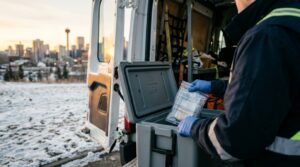
A blood tube sits in a courier’s van on Deerfoot Trail at 4:45 on a Friday afternoon. The lab closes soon. Everyone involved is watching the clock.
STAT medical transport in Calgary runs on two things: speed and paperwork. The speed gets a sample to the lab. The paperwork proves the sample stayed untouched on the way.
Most of what follows comes down to habits. Seal it. Log it. Keep it at the right temperature. Get a signature at every handoff.
What STAT medical transport actually means
STAT comes from the Latin statim, meaning “immediately.” In a clinic or lab it means the sample can’t wait for the afternoon route.
A STAT run gets one driver and one vehicle. No extra stops. No shared loads. That’s the same model as our hot shot delivery service, which is why the two terms overlap so often in Calgary.
Who books STAT runs
A wider crowd than you’d guess:
- Family and walk-in clinics sending urgent bloods
- Surgical and dental offices sending pathology specimens
- Pharmacies moving refrigerated or time-limited products
- Veterinary clinics and research groups with samples that spoil fast
STAT versus routine lab pickups
| Routine pickup | STAT run | |
| Timing | Scheduled window | Dispatched right away |
| Vehicle | Shared with other stops | Dedicated to your sample |
| Route | Multiple stops | Direct to the lab |
| Custody record | Often batched | One driver, pickup to delivery |
| Best for | Daily routine samples | Urgent or time-limited samples |
Routine pickups are fine for routine work. Samples that can wait until morning fit our next-day delivery service without the same-day premium. If a result decides tonight’s treatment, the STAT run earns its price.
When STAT is worth the cost
| Pros | Cons |
| Fastest option available | Costs more than scheduled routes |
| One driver means a shorter custody record | Needs a clear deadline and a contact name at booking |
| Fewer chances for temperature drift | A dedicated vehicle may be overkill for routine work |
| Pickup typically within 30 to 60 minutes | After-hours runs depend on driver availability |
Chain of custody, explained
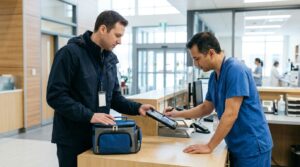
Chain of custody is a written record of who held a sample and when. Every handoff gets a signature and a timestamp. If the record has a gap, the lab has to assume the worst.
The idea comes from forensic work, where a missing link can get evidence thrown out. Clinical labs use a softer version of the same logic.
What a good custody record contains
- Sample ID or barcode, matched to the requisition form
- Collector’s name plus collection date and time
- Pickup address, pickup time and driver’s name
- Seal number on the tamper-evident seal (bag or cooler)
- Temperature at pickup and again at delivery
- Delivery time plus the receiver’s printed name and signature
If any line is blank, the audit trail has a hole in it.
Why one gap can sink a result
Here’s a typical gap. A driver collects a tube at 2:10 p.m. and the lab logs it at 3:40 p.m. Where was it for those 90 minutes? If the record can’t say, the lab may reject the sample.
The patient gets a second needle. The doctor waits longer for a result.
Workplace drug testing and legal matters raise the stakes further. A broken chain can get a result challenged in court.
Paper, digital or both
Paper works when somebody actually fills it in. Digital records add timestamps that can’t be backfilled later.
I lean digital for STAT runs because a driver’s hands are full and a tap beats a pen. One client on our site says she could tell instantly when a package arrived and who signed for it. That’s the standard to aim for.
Clinical, workplace and forensic samples
A routine clinical sample needs a clean record. A workplace drug test or a forensic sample needs a stricter one, usually with a signature at every single transfer and a sealed container that stays sealed until the lab opens it.
Tell your courier which type you’re sending. The handling rules change with it.
A STAT run from booking to signature
| Step | What happens | What gets recorded |
| 1. Booking | You share sample type, temperature range, deadline and a receiving contact | Booking time and instructions |
| 2. Dispatch | A driver is assigned and heads to you | Driver name and dispatch time |
| 3. Pickup | The driver checks the label, seal and requisition then loads the cooler | Pickup time, seal number, temperature and your signature |
| 4. Transit | Direct run with no extra stops | Any delay and its cause |
| 5. Delivery | Lab staff check the seal and sign | Delivery time, receiver’s name and signature |
| 6. Confirmation | The record goes back to you | A complete audit trail |
What to tell your courier at booking
- What’s in the box (blood, urine, tissue or something else)
- How it’s classified: Category B (UN3373) or an exempt specimen
- The temperature range from your lab’s instructions
- The hard deadline
- A phone number at pickup and another at the destination
- Anything unusual, like dry ice
Ten seconds on the phone saves a lot of grief later.
Sample handling by temperature
Sample integrity depends on temperature more than on anything else a courier controls. Your lab’s requisition sets the range. The courier’s job is to hit it and write it down.
| Category | Typical range | Common examples | Watch for |
| Ambient | 15 to 25°C | Many routine blood tubes | Freezing in winter vans and heat in parked cabs |
| Refrigerated | 2 to 8°C | Some serum and urine samples; certain pharmaceuticals | Ice packs touching tubes can freeze them |
| Frozen | −20°C or colder | Certain plasma and specialty tests | Thawing during delays |
Those are typical ranges only. Follow your lab’s instructions every time.
Time limits
Some samples hold for hours. Others, like blood gas samples, need to reach the lab fast. Put the deadline on the booking. A rushed phone call from the parking lot is too late.
Dry ice and frozen shipments
Dry ice has its own dangerous goods rules (it ships under UN1845). Tell your courier before pickup. It also releases carbon dioxide gas, which builds up in a closed van cab, so the driver needs to know to ventilate.
Packaging and labelling rules in Canada
Transport Canada regulates this under the Transportation of Dangerous Goods (TDG) Regulations. Anything known or believed to contain an infectious substance is Class 6.2. From there it lands in Category A or Category B.
Most routine patient specimens that might carry a pathogen travel as Category B. The shipping name is UN3373, Biological Substance, Category B. Specimens with a minimal chance of pathogens can qualify as exempt human specimens, which carry lighter rules. Your lab or clinic makes that call. The driver doesn’t.
Transport Canada’s guidance on shipping infectious substances explains each category. Bookmark it.
Triple packaging
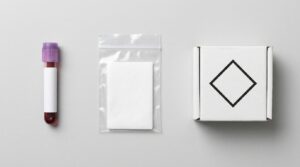
Biological samples travel in three layers.
Primary container
A sealed, leakproof tube or vial with a label that matches the requisition.
Secondary packaging
A second leakproof layer with absorbent material inside. There should be enough to soak up all the liquid if the primary container fails.
Outer packaging
A rigid box or cooler that protects the inner layers. Packaging built to Packing Instruction 650 (P650) is a common choice for Category B.
Need empty collection kits or packaging supplies at a clinic first? Those travel as parcel delivery shipments.
The UN3373 mark
Category B packages carry a diamond-shaped mark reading “UN3373” on the outside. The words “Biological Substance, Category B” go next to it in letters at least 6 mm high.
When a shipment meets the conditions in section 1.39 of the regulations, it can travel without a shipping document. The mark still has to be there.
Training and privacy
TDG training is required for people who handle or transport dangerous goods. Certificates need renewing at least every 3 years. Ask a courier when their drivers last renewed. Don’t take “yes, we’re trained” on faith.
Privacy counts too. The TDG rules don’t require a patient name on the shipping mark. Alberta’s Health Information Act also covers health records, so requisitions should stay sealed in their own pocket. A driver has no reason to open them.
STAT medical transport in Calgary: what changes on the ground
Cold, heat and Chinooks
Calgary winters can drop below −25°C. A van parked for 10 minutes in that cold can freeze a tube that was meant to stay at room temperature. Chinooks swing the other way, with 20 degree jumps in a single day. And a parked cab in July gets hot fast.
Good couriers use insulated coolers year-round. They keep samples off the van floor and out of direct sun. That’s basic cold chain discipline.
Traffic and distance
Calgary is wide. A run from a clinic in Okotoks to a lab in the northwest can cross Deerfoot Trail, Glenmore Trail and Crowchild Trail in one trip. Rush hour changes everything.
Transit time matters because the sample’s clock keeps running while the van sits in traffic. Our same-day courier service typically has a driver at pickup within 30 to 60 minutes. Delivery is usually done in 2 to 3 hours depending on distance. That covers Airdrie, Cochrane, Chestermere and Okotoks as well as the city itself.
Hospital sites like Foothills Medical Centre and the Alberta Children’s Hospital have their own receiving rules. Ask the destination lab where to drop off and who signs.
Longer hauls
Samples don’t always stay in Calgary. A hot shot run can reach Edmonton, Red Deer, Lethbridge or Medicine Hat with a dedicated vehicle and one driver. Fewer handoffs means a shorter custody record.
Mistakes that cost labs their samples
- Booking without saying it’s a biological sample. The driver can’t handle what they don’t know about.
- Skipping the deadline. Without one, nobody can prioritize the run.
- Packing ice packs against the tubes. Direct contact can freeze a sample that should only be cold.
- Accepting “left at the front desk.” Every delivery needs a named signer.
- Reusing a cooler without wiping it down. Residue from the last run is a contamination risk.
- Mixing medical samples with other parcels in one box. Keep them separate and sealed.
How to vet a medical courier
Before you sign anything, ask:
- Are your drivers licensed, insured and in uniform?
- Who holds current TDG training?
- Do you have a written custody procedure I can read?
- How do you handle temperature, and can you log it?
- Can I see who signed and when after delivery?
- Who answers the phone when something goes wrong?
Experience counts here. A company that has run Calgary routes for over 30 years has seen every road closure and every February cold snap. You can read more about City Wide Courier on our site.
Where City Wide Courier fits
Our pharmaceutical courier in Calgary service is built for clinics, pharmacies and medical labs, with temperature-aware handling. Drivers are licensed, insured and uniformed. Dispatch starts the moment your request comes in.
Tell us what’s in the box when you book. We’ll match the vehicle and the handling to the sample.
FAQs
How fast can a STAT courier reach me in Calgary?
We dispatch a driver as soon as your request comes in. Pickup usually happens within 30 to 60 minutes. Delivery typically finishes in 2 to 3 hours depending on distance. A dedicated hot shot run is the quickest option.
Can I book outside business hours?
Our regular hours are Monday to Friday, 8:00 AM to 5:00 PM. For after-hours emergencies call (403) 246-8349 and we’ll do our best to help.
Does my courier need to know what’s in the box?
In general terms, yes. Tell them it’s a biological sample along with its classification (for example Category B, UN3373) and the temperature range. They don’t need a diagnosis. The sender, usually the lab or clinic, is responsible for classifying and packaging the sample.
What happens if a sample is delayed or a cooler is damaged?
Call the lab right away. Write the time and the reason on the custody record. The lab decides whether to test, flag or reject the sample. Hiding a delay only makes things worse.
How much does STAT transport cost?
It depends on distance, vehicle, urgency and time of day. A dedicated run costs more than a scheduled route because the vehicle is yours alone. We give free quotes and you don’t need an account.
Can I see who signed for my delivery?
Yes. Our online accounts keep an order history. Clients tell us that’s how they confirm the delivery time and who signed. Ask for the same from any courier before you book.
Get your samples there with a signed record
STAT medical transport in Calgary works when four things line up: speed, temperature, packaging and a signed record for every handoff. Miss one and the lab has a reason to doubt the result.
Before your next booking, write down the sample type, the temperature range and the deadline. Send them with the request. Ask for the signed record when the run is done.
Need a driver now? Request a free quote or call City Wide Courier at (403) 246-8349. No account needed.
One Response